Showing posts with label Books. Show all posts

December 7, 2013

Yes, I Say, Yes

I have three novels remaining to read in Barbara Hambly’s Benjamin January series. As is my usual habit in December, I do not post a review because I like to relax and read a book without taking notes or doing any profound thinking. I thought I’d blog about book reviewing.

Some newspapers and magazines have stopped reviewing books, but websites devoted to book reviews are all over the Internet. What prompted me to think about book reviewing was a post by Andrew Beaujon on the Poynter website in which he discusses the decision by Isaac Fitzgerald, the new book editor at Buzzfeed, not to do negative reviews. According to Beaujon, Fitzgerald said BuzzFeed won’t do negative reviews:

“Why waste breath talking smack about something?” he (Fitzgerald) said. “You see it in so many old media-type places, the scathing takedown rip.” Fitzgerald said people in the online books community “understand that about books, that it is something that people have worked incredibly hard on, and they respect that. The overwhelming online books community is a positive place.

I say yes to negative as well as positive book reviews. I glanced at some online comments objecting to Fitzgerald’s stand on the matter, but didn’t have time read them thoroughly, so I can’t say if people mostly agree or disagree with him.

Reviewers are important to the book community because they help readers select books through a good analysis and tell them what to expect in terms of theme, plot, and characters. As an article “How to Write a Book Review” on the Scholastic.com website puts it

A critical book review is not a book report or a summary. It is a reaction paper in which strengths and weaknesses of the material are analyzed. It should include a statement of what the author has tried to do, evaluates how well (in the opinion of the reviewer) the author has succeeded, and presents evidence to support this evaluation.

Good book reviews save readers time. Without them, readers would have to wade through the thousands of books published each year, a task I think most readers would prefer to avoid. Whether a book is bad or good, the reviewer should encourage the reader to read it and judge for himself. While I may not like a book, readers might enjoy it. Of course, some books are so badly written that you wonder how they got published.

A reviewer should never review a book with a predisposition to like or dislike it. He should make his judgment after he has finished reading and thought about the book. If possible, he should read it twice, first to get a sense of what it is about, and second to analyze its merits and demerits.

The book community is indeed a positive place but it cannot escape the negativity in the world by ignoring it.


Happy reading and 

August 3, 2013

A Slight Misstep


“You know what they say of white men in Louisiana…They come here seeking fortune, but all they find is a wet grave”

Should a critic confess that he can’t pin point why a novel by a novelist he has praised in the past is disappointing? Yes, and I so confess. No matter how good a storyteller a writer is, if she is also prolific and her main character is a series protagonist, the quality of her novels will, at some point, drop. Such is the case with the sixth novel in Barbara Hambly’s Benjamin January series.

In Wet Grave amateur detective Benjamin January and his friend Rose Vitrac, the deceptively beautiful and scholarly former girl’s school teacher, investigate two murders.

Benjamin’s sister Olympe summons him to view the body of an old, drunken Black woman. He immediately recognizes Hesione LeGros whom he last saw 23 years ago when he was 16 and playing the piano at a party for Jean Lafitte’s band of pirates. The two of them had hidden behind the piano when a fight broke out among the guests. In her younger days, she was the mistress of one of Lafitte’s pirate captains.

Knowing that the authorities will not come and take away the body or investigate the murder of an old free Black woman, an angry Ben with his friend Rose decides to find out who killed Hesione and why. The investigation leads them to one of Jean Lafitte’s former pirate captains named Cut-Nose Chighizola, who might tell them more about the dead woman.

The failure of the authorities to investigate Hesione’s death causes Ben to direct his anger at the one White policeman friend he has, the Kaintuck, Lieutenant Abishag Shaw. “Anger flared up in” Ben “briefly, like kindling. It ignited a bigger log, an anger that did not leap and glare but that burned slow and deep and hot.” But he knows it isn’t Shaw’s fault because, he says to Shaw, you are “doing your duty, and going where you’re sent.” In the subplot, Shaw is sent to the Avocet plantation to investigate the alleged killing of Guifford Avocet by his brother Robert.
Ben’s anger is further stoked when he and Rose learn that 16-year-old Artois St. Chinian, an octoroon Rose was tutoring, is killed because he mistakenly received a box containing guns instead of the vacuum pump he had ordered.

The investigation of the two murders propel Ben and Rose into a battle against rebelling slaves, criminals hunting for Jean Lafitte’s buried treasure, and a hurricane that brings ashore alligators and snakes.

Wet Grave is not filled with as much action as the preceding novels. The romance between Ben and Rose, though expected and necessary, slows the pace of the action somewhat. Furthermore, despite the danger in which Benjamin and Rose find themselves, I didn’t feel the tension the situation should generate and, consequently, I had no sense of relief once the danger had passed.

The slow pace is due primarily to a problem with all serial novels: the author has to repeat the backstory of the protagonist so that the novel stands alone, even though it is one in a series. At the same time, the author must provide continuity with the other novels in terms of setting and especially the serial protagonist.

A few days after finishing the novel, something still kept nagging at me in the back of my mind, clamoring that something was wrong. What’s wrong is the Avocet subplot does not fit. Hambly does a good job of completing the plot within itself, but, despite the need for it as a plot device, it often tends to distract from rather than advance the main plot.

Despite the flaws, Wet Grave is still readable due to the magic of Hambly’s storytelling. In this novel, Hambly is like a person climbing stairs and misses a step; she stumbles but rights herself and continues.

July 6, 2013

Pulp Fiction Black Style


I took a break from reading Barbara Hambly’s Benjamin January detective series to read a collection of pulp stories by several African American writers. In the introduction of Black Pulp, (edited by Tommy Hancock, Gary Phillips, and Morgan Minor) Walter Mosley notes that pulp “stories got right to the point on the first page and kept your heart rate up until the final word.”

The pulp magazines published genre stories--crime, horror, westerns, science fiction, fantasy, adventure, romance, and thrillers. The stories did what the editors, publishers, and readers wanted them to do. They entertained. What wasn’t in the magazines were stories by African American characters that featured Black characters. No editor or publisher would accept any stories by Black or White writers in which the hero was Black because their White readers wouldn’t accept them. Moreover, Black writers and readers were too busy fighting for civil rights, which required great mental and physical effort, to write and read for mere entertainment.

Unfortunately, the pulp magazines died in the 1950s. If they were alive today, editors and publishers certainly would accept the stories in Black Pulp. The dozen stories are of varying degrees of quality, but are readable and enjoyable.

Something you wouldn’t have expected in the pulps during the golden age is a story by a woman featuring a Black Female heroine. “Agnes Viridian And The Search For The Scales” by Kimberly Richardson is the only story by a woman in the anthology. The heroine of this fantastic story is private investigator Agnes Viridian. She doesn’t know she is an agent of the gods when a man hires her to find his brother and retrieve a set of “very old scales” the brother stole from him. She is a kickass woman who I wouldn’t want to tangle with in a dark alley.

Another surprising story is “The Lawman” by Ron Fortier. It is a fictionalized version of the exploits of the real African American U. S. Deputy Marshall Bass Reeves, whom Fortier says was the “greatest western lawman of them all.” In the epilogue, Fortier claims Reeves “brought in over three thousand felons, was involved in fourteen major gun battles and only wounded once.” Yes, we helped open the west.

Tarzan, was he White or Black? In Charles R. Saunders’s story “Mtimu” (Wild Man), he is Black and named Yeke. In the opening is a bit of Black history as Mtimu rescues the Black woman aviator, Enid Brown, a character based on the first Black female flyer Willa Brown. Yeke was raised by a Black scientist, the Lost Professor, who had come to Africa to study wild life and by a group of Soko apes. Mtimu is a good adventure story using the Tarzan trope.

While most of the stories are very entertaining, the adventure story “Rocket Crockett and the Jade Dragon” by Christopher Chambers merely irritated me because of how badly it is written. Rufus “Rocket” Crockett is a black navy aviator involved in recovering a Jade Dragon artifact stolen from Korea by the Japanese during WWII and bringing to justice a Japanese gangster who is really a wanted war criminal. The gangster is a caricature, and speaks Hollywood’s version of how a Japanese pronounces English words, especially “r”. He says “brack” for “black.” Clichés abound, as do black and white stereotypes: Ship captain a good old southern boy who, surprisingly, respects Rocket. Padding, plenty of it.

Sometimes I wonder if certain types of books are necessary. In Black Pulp, the writers seem anxious to prove they can do pulp fiction. This would be a good thing if the pulp magazines were still alive and flourishing. However, if you enjoy reading genre fiction, especially the old pulp stories, you’ll like Black Pulp. The stories are good. I just don’t think Black writers in the 21st century have to prove they can write the type of stories that were prevalent during the golden age of pulp fiction.


December 1, 2012

A Few Random Thoughts


MERRY CHRISTMAS: 


Now that that traditional greeting is out of the way, I can get on with the post for this month. I had planned this month to post a critical review of the first novel in the Barbara Hambly’s Benjamin January series. I decided instead to review it in February 2013 and to review the other nine novels in the series in remaining nine months of 2013. The 10 novels feature Hambly’s believable 19th century African American detective.

Why February? Well, I have to post my review of a novel that I read in November before embarking on my adventure through 1830s New Orleans with Benjamin January.

Every December, to give my brain a break, I relax from reading crime fiction by reading a so-called literary novels. I choose the novels at random. This year I plan to read two novels—Never Let Me Go by Kazuo Ishiguro and Tumbling, a first novel by Diane McKinney-Whetstone. If I can find the time, I might read one of the novels I have on my Kindle or Nook. On the Kindle, I have current crime fiction, and on the Nook, I have crime novels from the 19th century that I downloaded from the Gutenberg website. 

Well, that’s it for this short and sweet post.

October 6, 2012

The Truth is Hard


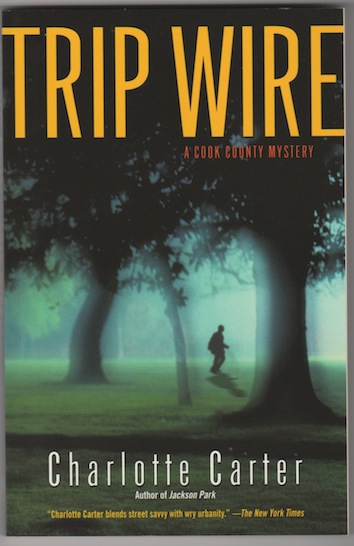
My favorite character is back in Charlotte Carter’s second novel featuring amateur detective, Cassandra. The twenty-year old college student I met in Jackson Park who made me want to slap the taste out of her mouth gets her grandaunt Ivy and Ivy’s husband Woody involved in another dangerous mystery-thriller in Trip Wire.  

A few months after solving the 20 year old murder of a White school teacher, Cassandra and her grandaunt Ivy and granduncle Woody investigate the murder of her best friend Wilton and his White girl friend Mia in a hippie commune where Cassandra lives with six other people. To prove she is independent and to annoy her aunt and uncle, she moved out of their home and into the commune, an apartment on Chicago’s north side. She met Wilton, the black member of the commune, in Lincoln Park during Bobby Seale’s appearance at the Democratic Convention in 1968.

In her usual impetus and annoying way, Cass can’t rest until she finds out who killed Milton and Mia. Like most 20-year-olds in the 1960s, she mistrusts  adults, especially, Ivy and Woody as well as the Chicago police, including her uncle’s detective friend Jack Klaus. During her investigation she discovers a Black militant organization called “The August 4 Committee” whose mission is to kill White Army officers they consider racists and who, they believe, murdered Black soldiers in Vietnam. She also learns about spies for the FBI and snitches for the Chicago police.

Carter deftly describes Chicago in late 1968 and by extension the entire nation as seen through the eyes of Cassandra.

My ROOM WAS GRAY AND MUSTY FROM CIGARETTE SMOKE. IT was long past sunrise, but light was hard to come by. The news is­suing from my clock radio was just as sunless and heavy-

Death toll for the week so far: 80. That was just "our" side. No figures on how many of the enemy incinerated. A Christmas truce was in the offing, and Bob Hope was on the way to Saigon.

Other headlines: Two children and their welfare mother as­phyxiated. Mix poor people with no heat and a faulty gas oven. Result, death. A drunk driver killed four teens on the highway.

In Cassandra, Carter has created the personality of an idealistic 20-year-old Black female rebelling against the system and having to learn to accept the truths she finds in the system. While talking about how drug dealers operate with Henry Waddell, the old gangster in Jackson Park, who has some past connection to Ivy and Woody, Cassandra realizes that she and Wilton had drifted apart:

Suddenly I realized how far away from Wilton I had traveled in just a few days. Maybe it was just a matter of knowing, accepting in a way I hadn't before, that he was dead and forever lost to me. But I don't think that was the whole answer. Accepting the death meant acknowledging how far away he had gone from me. What I was remarking on now was how far away I had gone from him. Curious that of all the friends and strangers I'd spoken to, it should be Henry Waddell who triggered this insight. 

Unlike her Greek namesake, it is not others who will not accept what she is saying, but Cassandra who must finally accept the truth of what she learns about herself and her grandaunt and granduncle.

If Charlotte Carter wrote another novel featuring Cassandra, I couldn’t find it on the Internet. So, if you know of another Cassandra novel, please let me know.