Showing posts with label hardboil. Show all posts

October 6, 2012

The Truth is Hard


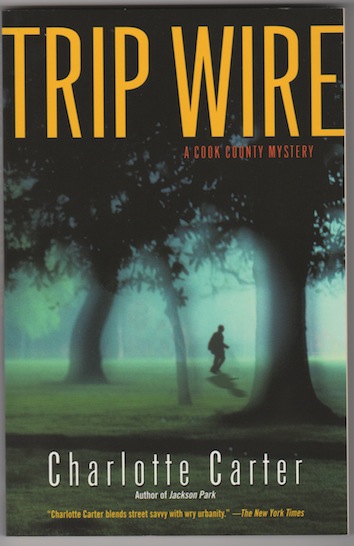
My favorite character is back in Charlotte Carter’s second novel featuring amateur detective, Cassandra. The twenty-year old college student I met in Jackson Park who made me want to slap the taste out of her mouth gets her grandaunt Ivy and Ivy’s husband Woody involved in another dangerous mystery-thriller in Trip Wire.  

A few months after solving the 20 year old murder of a White school teacher, Cassandra and her grandaunt Ivy and granduncle Woody investigate the murder of her best friend Wilton and his White girl friend Mia in a hippie commune where Cassandra lives with six other people. To prove she is independent and to annoy her aunt and uncle, she moved out of their home and into the commune, an apartment on Chicago’s north side. She met Wilton, the black member of the commune, in Lincoln Park during Bobby Seale’s appearance at the Democratic Convention in 1968.

In her usual impetus and annoying way, Cass can’t rest until she finds out who killed Milton and Mia. Like most 20-year-olds in the 1960s, she mistrusts  adults, especially, Ivy and Woody as well as the Chicago police, including her uncle’s detective friend Jack Klaus. During her investigation she discovers a Black militant organization called “The August 4 Committee” whose mission is to kill White Army officers they consider racists and who, they believe, murdered Black soldiers in Vietnam. She also learns about spies for the FBI and snitches for the Chicago police.

Carter deftly describes Chicago in late 1968 and by extension the entire nation as seen through the eyes of Cassandra.

My ROOM WAS GRAY AND MUSTY FROM CIGARETTE SMOKE. IT was long past sunrise, but light was hard to come by. The news is­suing from my clock radio was just as sunless and heavy-

Death toll for the week so far: 80. That was just "our" side. No figures on how many of the enemy incinerated. A Christmas truce was in the offing, and Bob Hope was on the way to Saigon.

Other headlines: Two children and their welfare mother as­phyxiated. Mix poor people with no heat and a faulty gas oven. Result, death. A drunk driver killed four teens on the highway.

In Cassandra, Carter has created the personality of an idealistic 20-year-old Black female rebelling against the system and having to learn to accept the truths she finds in the system. While talking about how drug dealers operate with Henry Waddell, the old gangster in Jackson Park, who has some past connection to Ivy and Woody, Cassandra realizes that she and Wilton had drifted apart:

Suddenly I realized how far away from Wilton I had traveled in just a few days. Maybe it was just a matter of knowing, accepting in a way I hadn't before, that he was dead and forever lost to me. But I don't think that was the whole answer. Accepting the death meant acknowledging how far away he had gone from me. What I was remarking on now was how far away I had gone from him. Curious that of all the friends and strangers I'd spoken to, it should be Henry Waddell who triggered this insight. 

Unlike her Greek namesake, it is not others who will not accept what she is saying, but Cassandra who must finally accept the truth of what she learns about herself and her grandaunt and granduncle.

If Charlotte Carter wrote another novel featuring Cassandra, I couldn’t find it on the Internet. So, if you know of another Cassandra novel, please let me know.


July 5, 2012

The Hunter Becomes The Hunted


Camacho’s first thriller, The Payback Assignment, disappointed me. He redeemed himself in his second thriller. Orion is packed with as the Electrifying Duo, Morgan Stark and Felicity O’Brien, battle a big, handsome, dangerous Irishman. Unlike the villain in The Payback Assignment, Ian Michael O’Ryan, who got the nick name Orion, after Orion, the great hunter in Greek mythology, while hunting big game in Africa, is bigger than life both physically and mentally.

Felicity’s Uncle Sean Sullivan, the priest of a small village in Ireland, comes to the U. S. to hire Morgan to help stop O’Ryan, whom he considers a terrorist, from recruiting the young men in the village. He believes O’Ryan wants to revive the IRA and restart ”the troubles” (religious wars). He doesn’t want O’Ryan killed, just stopped.

When the Electrifying Duo arrive in the village, Morgan, a Black man in Ireland, knows he’ll have to out drink and out fight the biggest dude in the pub to be accepted. He challenges and defeats Max Grogan in arm wrestling and drinking contests, thus becoming a hero to the patrons.

Once he is comfortable with the residents of the village, he and Felicity devise plans to stop O’Ryan. She devises the first of three plans. O’Ryan gets money he needs for his operation in Ireland from organizations that sponsor terrorism. She cleans out his bank accounts, which lack of ready cash puts him in a bind. Sorry, to explain how she does it would be a spoiler.

Morgan directs the operation to deprive O’Ryan of arms he has bought for a Middle Eastern terrorist. When the shipment arrives on the Irish coast, with the help a group of gypsies among whom Felicity lived after running away from home when she was 16, he makes sure the arms will not get to O’Ryan. O’Ryan must refund the customer’s money.

To get the money, he enters a motorcycle race in France, which he has never lost. Morgan enters the race under the Seagrave Industries sponsorship and riding one of their bikes. His objective is not to win but to make sure O’Ryan loses. Of course he knows O’Ryan will have his henchmen station along the course to take out any rider in the lead. A fact that spices up the scenes of the race.

O’Ryan doesn’t take Morgan’s interference very well. His men later ambush Morgan, who takes out three of them before they subdue him. O’Ryan holds Morgan on an island off the coast of southern France. Believing Morgan works for a government agency, he enjoys torturing him to try to get him to reveal which agency.

With her partner missing, Felicity goes into action. She doesn’t accept the possibility that he might be dead. he is too far away for her to sense his presence. But she is able from the direction in which the van fled to start out on the trial. She and Paul continue to the coast until she senses she is close, and learns about an isolate island. Once she is on the island and inside the house, she tangles with O’Ryan.

But it isn’t over. As Felicity is wheeling Morgan out of the hospital, they feel danger but too late to get back in the hospital. A man named Youssef and his henchmen stop them. The electrifying duo, Claudette, and Paul face their guns. Youssef was O’Ryan’s customer and now he blames Morgan for causing him to lose the weapons. Again, I can’t be a spoiler.

Camacho makes sure his readers are on the side of good when he has O’Ryan suggest that Morgan is no different from him—both are in a way mercenaries. However, Morgan considers what he does—helping other honest folks—as an honor. O’Ryan’s terrorist activities are about power. Orion is better than The Payback Assignment because it is better plotted and the villain is more worthy of the Electrifying Duo’s many talents.

The introduction of O’Ryan’s customer at the end disappointed me. It was a loose end that didn’t need wrapping up.


April 7, 2012

Blood Will Tell


In Blood and Bone, Austin S. Camacho’s fourth novel in his Hannibal Jones series, the Washington PI takes on a missing person case.

The novel is a sort of family saga. When he is hired to find, Jacob Mortimer, the estranged son of a Black millionaire Harlan and father of 18 year old Kyle, Hannibal has to work against time. Kyle needs a bone marrow that only Jacob can provide, or he will die in a few weeks. Abandoning his wife Camille and new born son 18 years ago, Jacob disappeared with a woman called Barbie and some of his father’s valuable coins.

In what starts out as a routine missing person case, Hannibal soon finds himself tangling with gangsters in New Jersey, helping solve a murder, and preventing a scheme to defraud Harlan Mortimer of some of his millions. His search for Jacob takes him from Washington DC to Baltimore, New Jersey, Texas, Virginia, and finally Mexico. Along the way, he discovers a young woman in Baltimore who is also looking for Jacob. In New Jersey and Virginia, he tangles with a two mobster brothers. In Texas and Mexico, his journey ends in a confrontation with some very bad people.

Camacho opens the novel in his usual violent style, which is also the beginning of the subplot. Hannibal beats two henchmen guarding the pimp Floyd in the Tip Top club so he can negotiate the release of an 18 year whore named Jewel who wants to get out of the business. Jewel will later get the evil eye and Hannibal the silent treatment from Cindy when she sees Jewel standing in Hannibal’s kitchen.

Camacho’s inventiveness is again on display, and he doesn’t waste words on pointless descriptions. He keeps the pace moving and sustains the suspense until the very end. The subplot involving finding Jewel’s mother seems at first as though it is merely there as relief from the violent action of the main plot but Camacho skillfully weaves it into the central plot while showing the evolving relationship between Hannibal and his girl friend Cindy.

The intricate plot of Blood and Bones with the clever twists and surprise identity of the bad guys will hold your interest to the very last word. Like me, you probably will want the story to continue even as Camacho neatly wraps up all the loose e

March 3, 2012

An Undamaged Novel


Austin S. Camacho’s third novel, Damaged Goods, in his Hannibal Jones series, is not as successful as his debut novel, Collateral Damage, but is much better than The Troubleshooter.
 
Millionaire Benjamin Blair hires PI troubleshooter Hannibal Jones to find the psychopath who seduced his Black maid Anita Cooper and stole  from her a formula worth millions of dollars that her pharmaceutical chemist father left her. Although Benjamin is generous toward his maid, he also wants the formula for his company.

Vernon Cooper, a Black pharmaceutical chemical genius, came up with a formula for curing addictions but kept it from his employer, a large pharmaceutical company. While serving time in prison for a hit and run accident, he meets Roderick Mantooth to whom he reveals the existence of the formula and the fact he left it with his daughter.

Rod creates the “damaged goods” of the title, women he seduces using BDSM, (bondage, discipline or domination, submission, masochism) to make them his slaves. The problem Hannibal faces is how to get into Rod’s group to find where he has hidden the formula. The case takes him into the unfamiliar, unsettling, and dangerous world of BDSM. Hannibal as a bad dude into kinky sex games while maintaining his integrity is the force driving the plot toward an unexpected and disappointing conclusion.

I enjoyed the humor of Hannibal posing as a bad dude into BDSM, and his attempt to make a rap CD to impress his young teenage friend Monty, the grandson of Mother Washington, the matriarch of the neighborhood where they live. He wants to save Monty from a life on the mean streets of Washington DC.

Hannibal has in his pocket an engagement ring and plans to ask girlfriend Cindy to marry him, which makes for pleasant suspense of will he or will he not pop the question. A married hardboiled PI would be a nice departure from tradition.

Although Damaged Goods is a routine crime story with no surprises (the ending ,though unexpected, isn’t a surprise), it is still an exciting novel with plenty of the usual fisticuffs and gunplay characteristic of Camacho’s other novels, and well worth your time if you like the action of watching the hero take down the bad guy as I do.


February 4, 2012

A Backstory Thriller


In debut novels, writers sometimes don’t provide extensive background information about the characters’ lives, which in many cases doesn’t matter, but if the protagonist is to be a series character, readers, the writer realizes, will want to know more about his history. This realization provides an excuse for a poorly structured follow-up novel. The Troubleshooter, Austin S. Camacho’s second novel is the backstory of how PI Hannibal Jones met the four homeless men who became his friends and part employees in his PI business, and how he met his love interest, the beautiful Cuban lady lawyer Cynthia (Cindy) Santiago.

Troubleshooter PI Hannibal Jones accepts a job clearing a building in a tough neighborhood in Southeast Washington DC of drug dealers, addicts, whores, and other criminal types. He needs the money and a place to live after the building in which he lived burns down, forcing him temporarily into a hotel.

Hannibal’s main adversary in this predictable crime thriller is Sal Ronzini, son of  mob boss Anthony Ronzini. After Hannibal evicts the fence who works for Sal from the building, along with the addicts, dealers, and whores, Sal comes after him. Over and over, Sal comes at Hannibal, and each time Hannibal beats him back but not without help.

In the opening, Hannibal negotiates a settlement with a bookie on behalf of ex-taxi driver Ray Santiago, father of Cynthia Santiago, for repayment of Ray’s gambling debts. He hires Ray to be his driver. He meets four homeless men with various skills at the shelter where he volunteers. Sarge is a Black Vietnam vet. Quaker is his White friend. Virgil is a Black former electrician and ex-addict. Timothy is a hot-headed Jamaican and plumber, who does not become a permanent employee as do the other four men. Hannibal’s crew evens the odds against against Sal’s thugs.

Hannibal discourages the residents of the neighborhood from trying to help because he doesn’t want any of them to get hurt.

The only interesting character in the novel is Anthony Ronzini. He explains why Sal refuses to quit trying to evict Hannibal. In the old days members of each ethnic group knew who they were in relation to other groups but cultural diversity and civil rights (“bunch of crap”) confused things, he tells Hannibal.

As Hannibal interprets it, Ronzini is saying “the boy don’t know any other way.”

“If I was another Italian, he'd know how to deal with me," Hannibal said, standing. "Or at least, he'd know he could deal with me. Sure. Sally probably only sees black guys as servants. Or customers. Maybe competitors. But not as men."

"He knows who he is," Ronzini said. "He doesn't know who you are. I mean, he thinks you're a nigger, but you don't act like a nigger. And he's still acting like a dumb wop.”

The novel is interesting because it provides background information about the serious character, Hannibal Jones. It is otherwise a forgettable.


January 7, 2012

Hannibal Jones, Troubleshooter


When I read reviews of crime fiction novels online and in newspapers and magazines, I always look for reviews of novels by Black writers, and finding such reviews sends pleasure through my old bones. I discovered Austin S. Camacho while reading the reviews in the online magazine “The Bookreporter.” According to the website fallforthebook Camacho “is active in several writer organizations, … is the 2005-2006 president of the Maryland Writers Association and is a regular speaker at various writer's and book lovers' conventions. He also currently teaches three writing courses at the Anne Arundel Community College.” Camacho works for the Defense Department and for several years has reported the news over radio and television for the American Forces Network.

In his discussion about the Black detective in crime fiction at the Bouchercon’s “Charmed to Death International Conference of Mystery Writers” Camacho stated, “It’s not about race. It’s about the characters. It’s about the mystery.

Like all good storytelling, hard-boiled stories revolve around the characters.”

However, he ends his discussion with the relevant observation that a Black writer of detective fiction can’t escape race because his character is Black: “So maybe, in a way it is about race. Because it’s about the characters more than it’s about the mystery.”

Camacho has written five detective and two action adventure novels. In his first novel, Collateral Damage, he introduces PI Hannibal Jones, son of a Germany mother and African American father. Hannibal considers himself a troubleshooter instead of a PI because, “Other people's troubles became his own. That was how he made his living since he resigned from the Treasury Department.” He is a tough guy who cares about the underdog. His working uniform is dark, wraparound Oakley sunglasses, a black suit and black gloves, black shoes, and in a holster under his right shoulder a Sig Sauer P229. He lives in a poor neighborhood in southwest Washington DC and drives a Volvo 850 GLT.

The opening of this complexly plotted novel begins the subplot. Monty, Hannibal’s 12 year old friend, has asked him to rescue Monty’s friend Nicky and Nicky’s mother from her abusive husband, Isaac. Hannibal shows up and knocks on the door. A big, pro-lineman type dude greets him in an unfriendly manner. He is about 2-3 inches taller and, at 325 pounds, about 100 pounds heavier than Hannibal. How Hannibal handles the situation illustrates Camacho’s skill at creating plot incidents to bring out the characters’ personalities.

Hannibal’s first job is a missing person case. Bea Collins, a middle-aged, successful Black interior designer who lives in an upscale neighborhood, hires him, at $500 a day, plus expenses, to find her missing fiancĂ©, a young white man named Dean Edwards. Hannibal thinks the young man may be a con man but doesn’t say so to Bea. He finds the young man and lets Bea know where he is. Soon afterwards, she calls Hannibal and tells him Dean may be in serious trouble.

When he reaches the Dean’s house, Hannibal finds bloody shoeprints leading to the bedroom where Dean is lying on the bed. He tells Hannibal that Oscar, his supervisor at the computer service firm where he works, is dead and that his mother killed him. Dean believes his mother killed Oscar because the murder weapon is the same knife used to kill his father, for which his mother was convicted. The police later find the knife in Dean’s apartment, making him the prime suspect.

The knife, or one similar to it, also was used in a murder 12 years ago in Germany. Bea persuades Hannibal to investigate Oscar’s murder to prove Dean didn’t do it. Hannibal soon finds himself not only trying to solve Oscar’s murder but the murder of Dean’s father 10 years ago in Virginia and a murder in his hometown of Berlin, Germany.

An Author’s debut novel, if it is good, is an invitation to read his other novels. Camacho’s Collateral Damage certainly invited me to become more familiar with PI Hannibal Jones, a tough, believable, and caring character.